
Kabhi East Kabhie West: India’s Globalization in Karan Johar Films (UG Dissertation)
This dissertation was written in 2022
Introduction:
Whilst deliberating the transnational reach of Bollywood cinema; filmmaker, producer and screenwriter Karan Johar noted, ‘I think the endeavour is to just make your film and then hope it travels as much as it can.’[1] This sentiment epitomises the industry’s pursuit of obtaining global appeal, which remained a prominent pursuit throughout the 2000s. This effort, although shaped significantly by Johar, originally emerged in 1991 amidst a rise of globalization that brought forth a ‘resurgent India’[2], which sought to disengage from the remnants of colonialism. Perhaps most central to this effort was the transformational economic liberalization, which solidified the nation’s position within ‘the coveted ranks of the global powers of the 21st century.’[3] Critics such as Rajni Kothari[4] contested the overall success of this venture since the role of the nation-state appeared to be in collapse, however Rupal Oza insisted that this demise was combatted by a ‘simultaneous solidification of global flows and the consolidation of local identities.’[5]
Rapid economic development aside, globalization has been equally credited with ‘gradually transforming [the culture] and self-image,’[6] as seen through India’s revised national agenda. This cultural shift was reflected and perhaps even heightened by a new wave of Hindi film[7], which prioritised depictions of consumerism as well as diaspora in films often ‘set in the West featuring lead characters [known as] non-resident Indians or NRIs.’[8] These figures personified the reimagined ‘relation between the nation-state and its capital-rich diaspora,’[9] which was presented alongside pronouncements of patriotism and devotion to the motherland to illustrate a newfound sense of modernity. Manifestations of this emerged from right-wing political agendas, primarily Hindutva, which was first adopted within the Indian Constitution in 1950. This ideological construct originally referred to those belonging to religions of Indian origin[10], specifically a commitment to ‘Hindu-ness’. However this evolved amidst India’s rampant globalization, steadfastly ‘endors[ing] Hindu chauvinism and upper Hindu caste hegemony’. Within this system ‘minorities are permitted to live within such a social system but only as long as they remain submissive to Hindu nationalism.’[11]
This preservation of the nation’s agenda subsequently exceeded Hindustani borders and was mobilized within the Global North by the NRI, who acted as a vehicle of both Hindustani and Western values. This was displayed within Bollywood cinema through the use of ‘Hinglish’ (a portmanteau of Hindi and English), Western clothing and Eurocentric lifestyles, all of which aided the construction of Indian modernity for the 21st century. The success of this amongst global audiences is a testament to how this format conveys ‘a modernity that is neither [Western] nor threatening to their fantasy of “tradition” that they never quite had to begin with.’[12] This dissertation will investigate how Karan Johar’s work formulated a set of films that were directly informed by the post-1991 era of Indian modernity, as seen most explicitly in Kabhi Khushi Kabhie Gham (2001), Kal Ho Naa Ho (2003) and My Name Is Khan (2010). My analysis will focus primarily on selected musical numbers from these films, for they are emblematic of the morals and ethics of a resurgent India. However, in spite of Bollywood’s emphasis on local identities, this dissertation will investigate the extent to which Bollywood films cater to the Western gaze and in turn, colonial ideals.
Before proceeding with this however, it would be most appropriate to address the surrounding discourse that has interrogated issues of globalization and national identity in Hindi film. Analogous to previous observations, much of the scholarly writing has readily regarded the NRI as integral to globalized Bollywood cinema due to ways in which the figure strives for modernity. Sangita Gopal’s contributions focus significantly on the ways in which the values introduced and enforced by the classic Bollywood era (from 1940s-1960s) were reworked in order to reconstruct the politics and narratives of 21st century cinema. Gopal asserts that these evocations of modernity prioritised critical depictions of the patriarchal family unit and forbidden romances[13] as a means of redefining the traditions that no longer complimented India’s developing social agenda. Additional critics also seek to retire the assumption that Indianness is synonymous with backwardness, particularly Gautam Basu Thakur, who expands upon Gopal’s perspective by observing that the modernity following globalization enables ‘oppositional values, positions and rhetoric to coexist.’[14] In other words, within the context of the NRI, assimilating within the West whilst embracing Indian values remains at the forefront of global Bollywood films in order to rewrite and embrace tradition as a means of extending beyond the nation’s borders.
This sense of coexistence developed into a hybridized identity that Jenny Sharpe’s work outlines, particularly in her paper ‘Gender, Nation and Globalization in Monsoon Wedding and Dilwale Dulhania Le Jayenge’, which recognises the sense of new nationalism produced by hybridities of global cultures.[15] Much of the discourse surrounding the industry’s globalization has observed the ways in which these dual identities are mirrored through combining Bollywood’s and Hollywood’s filmic styles. Sharpe’s analysis of Monsoon Wedding (2001) and Dilwale Dulhania Le Jayenge or DDLJ (1995) is no different, as the former is an international co-production primarily between India and the US, whilst the latter is widely regarded as Bollywood’s first global film. Despite the differing production contexts, both films cater to diasporic audiences substantially by unpacking the stereotypes associated with the NRI. These assumptions often consist of a complete disregard for Indian values, or an overfamiliarity with the ideals, therefore the listed films seek to contradict such assumptions in order to find a middle ground between East and West, which ultimately encapsulates the Bollywood industry’s and in turn, the nation’s political efforts.
Diaspora audiences have equally been subject to analysis, most notably in Rachel Dwyer’s chapter ‘Bollywood Empire Indian Cinema and the diaspora’ in Routledge Handbook of the South Asian diaspora. Dwyer reflects on the ways in which depictions of diasporic communities by the Hindi film industry resulted in growing responses from diasporic audiences themselves. In particular, the community developed a strong influence both economically and culturally, which Dwyer also assesses through DDLJ. The film’s central protagonist Raj is the focus of this argument, as he must prove his capacity to act as the modern Indian who defies tradition in some moments whilst embracing it during others – thus embodying the ‘global transnational Indian’[16] and becoming a paragon for the diaspora as well as native communities.
This literature consistently alludes to the importance of catering to both local and global audiences, which is substantially applicable to Johar’s body of work, however the limitations of these efforts must also be noted. Priya Joshi references Bobby (Raj Kapoor, 1973) and Kabhi Khushi Khabie Gham (2001) to argue how Bollywood’s effort for social consciousness is entirely limited, most often at the expense of resident Indians. This is because the NRI’s transnational appeal resides in the attainment of exuberant wealth, which ‘erase[s] whole sections of the public altogether. It’s India is scrubbed clean of labour and poverty’[17], which depicts a version of Indianness that avoids overwhelming NRI audiences with the supposed foreignness of the Third World. Critics such as Ingrid Therwath have argued that the NRI project is expanded by ‘shining Indians’, who promote national identity through their exemplary behaviour in response to prejudice. She writes, ‘here the expatriate Indian is not so much presented as a model for his compatriot. On the contrary he is presented as a model for Westerners thanks to his sense of solidarity and courage in the face of adversity.’[18] It has been established that Johar’s films heavily centralize assimilation within the Global North in order to appease the Western gaze (in this case diasporic audiences), however, Therwath insists that much of Bollywood’s social commentary additionally caters to a white Western gaze, which develops progressively throughout Johar’s career following the complexities of race relations following 9/11.
The literature I have presented thus far demonstrates how India’s globalization has centralized a newfound modernity in the post-1991 era. Although the morals and values of the NRI are integral to this process, I would argue that Priya Joshi in particular has overlooked the presence of class and wealth in relation to the nation’s colonial history. The implementation of Western capitalism during the reign of the British Raj was thoroughly reinforced throughout the nation’s economic liberalization, this involved methods of neoliberal capitalism as a practice of social mobility that provided access to the Western world. My first case study Kabhi Khushi Kabhie Gham (referred to henceforth as K3G) is illustrative of this due to the prominent themes of hard work and accomplishment obtained through adhering to such methods. However, this is additionally complicated by the persistent implementation of Hindustani values that ultimately defines the tone of the film in ways that will be interrogated during the first chapter.
Not only does Bollywood insist that wealth obtained by capitalist means guarantees a standard of success and opulence set by the West, but there is also an immediate confirmation of assimilation in doing so. Therefore, I will subsequently address how this dynamic has evolved into the hybridised identity comprised of Eastern and Western ideologies, which insists that modernity lies only in the hands of Indians abroad. Johar reflects this through his film style and adherence to Hollywood genre conventions, particularly in Kal Ho Naa Ho, which will be analysed in chapter two for its complex political approach to this issue. Jenny Sharpe’s critique of Bollywood’s globalization within the Western context theorises that the occupiers of these hybrid identities became heroes of the diaspora community, not only for their capacity to perpetuate patriotic ideals, but additionally for their capacity to assimilate within the West. Although this effort is often commended and encouraged in global Bollywood films, it has yet to be argued how Bollywood condemns NRIs who become ‘too’ Westernized (for being supposedly distant from their national pride) and those relentlessly attached to tradition (who are assumed to be isolated from the gleaming future of Indian modernity). Although Dwyer alludes to this throughout her analysis of DDLJ’s Raj, I would argue that the discourse has yet to acknowledge the cultural hierarchy that is generated to consolidate the nation’s idealisms.
Therwath does note the shining Indian’s solidarity with the West, however my research will note the ways in which this figure becomes personally responsible for redefining the West’s misconceptions of India through declarations of Western patriotism. The ramifications of 9/11 on the desi community acted as a catalyst for this outcome, whereby assimilation was overtaken by attempts to disassociate from affiliations with terrorism. No Bollywood film is more emblematic of this than My Name is Khan, the subject of my third chapter, in which I will apply the model minority complex to discuss further complications between NRIs and the West. Although critics such as Jasbir K. Puar and Amit S. Rai have revealed the growth of model minorities in film as a counterterrorism response, their discussion is concerned primarily with British films that depict Asians, such as Bent It Like Beckham (2003). My research would benefit from mapping the relation between Bollywood and the model minority myth, as it relates to the NRI’s pressure of maintaining a standard of modernity determined by the West.
Overall, this dissertation will implement and expand upon existing discussions, which relate to Karan Johar’s active involvement in depicting the globalization of India onscreen. This introduction touches on the complications and intricacies of presenting India’s new national agenda, however what remains consistent is adherence to Western ideals. This consequently reflects colonial thinking, and becomes progressively more prominent with each cinematic endeavour, ultimately shaping the politics of Johar’s films.
Chapter One: The Hindutvavadis – Khabi Khushi Kabhie Gham (2001)
In 2004, Marika Vicziany wrote, ‘The most palpable evidence for globalization in India today is to be found in foreign funding to a virulently right-wing Hindu nationalism that had gripped the country in the last ten years’[19] This correlates with Bollywood cinema as the industry has ‘actively engaged in the politics of nationalism engendered by the right-wing neo-fundamentalist Hindutva movement.’[20] One of the most successful and relevant manifestations of this is Kabhi Khushi Kabhie Gham; a domestic drama following the affairs of the New Delhi Raichand family, consisting of billionaire businessman Yashvardhan or Yash (Amitabh Bachchan), his wife Nandini (Jaya Bachchan), adopted son Rahul (Shahrukh Khan) and biological son Rohan (Hrithik Roshan). Tradition, religion and patriarchy are foundational to the family structure and are consistently enforced by autocratic Yash whose rigid parameters prohibit objection and disobedience. This becomes contentious when Rahul falls in love with the outspoken, working-class Anjali from Chandni Chowk, resulting in Yash’s dismissal of his son.
This chapter will present the ways in which wealth and Hindutva are used to prove India’s capacity for progressive living, which is rooted in the desire to relinquish the colonial narrative that India is synonymous with poverty and primitivity. Being as the film’s perception of modernity is informed by the nation’s globalized outlook, it should be noted that the framework of progress adopted by Johar derives from the West, which substantially shapes the film’s politics. The politics I refer to is a dependence on Western capitalism, which is promoted in order to project a gleaming middle class that is on par with Western standards of wealth. I will then outline the complexities of this simultaneous acceptance and rejection of the Western gaze, which Jenny Sharpe prefaces; ‘Historically the moral universe of commercial Indian cinema is a world in which social duties, love of nation, and kinship bonds outweigh individualism and personal desires. The 1990s family melodrama broke with this convention by giving value to the acquisition of new wealth and the pursuit of personal desires.”[21]
The implications of India’s economic liberalization brought forth a change in global representations and perceptions of India from a ‘“Third World” country to the “next great economic superpower.”’[22] The Bollywood industry was a central accoutrement to reshaping the image of Indian identity by operating as a vehicle of ‘the Indian state and the corporate sector in efforts to brand the country as an economic powerhouse.’[23] This renewed national agenda is particularly apparent in the Raichand family’s opulent lifestyle, which is attained through Yash’s contribution to India’s thriving economy. Thomas Blom Hansen’s inquiry of Indian globalization and the rise of nationalism during the 80/90s insists that the capitalist model following 1991 ‘created considerable excitement among the urban middle classes, who now began to envisage their own integration into global patterns of consumption and lifestyles.’[24] However this capacity to benefit from the Western system of capitalism additionally promoted the view that hard work and prosperity were intrinsically tied to Hindustani ideals. These ideals take the shape of Hindutva (whose followers are known as Hindutvavadis), which ‘incorporates a territorial dimension that is consistent with the Hindus’ definition of their ‘sacred land’ (matribhoomi), and an element of openness generally associated with ‘political nationalism’.[25] With this in mind, Hansen’s observations specify, ‘Hindu nationalism criticises ‘western philosophy’ for producing inhumane disharmonious societies, and it reproduces critiques of rationality and exploitation which have accompanied modernity and organised capitalism from the outset’[26] thereby unveiling the paradoxical quality of India’s relationship with the West as seen in K3G.
The Raichand family’s role as Hindutvavadis is evident in images of wealth established during the film’s first musical number, appropriately entitled ‘Kabhi Khushi Kabhie Gham’. As Diwali celebrations proceed, a striking establishing shot of the Raichand mansion unveils its enormity, which continues as the spectator is welcomed into the home. The interior footage boasts striking architecture consisting of sweeping staircases, vast foyers and theatrically large bedrooms, all of which are heightened through countless guests in vibrant clothing who adorn the home with further grandiosity. As well as this, ‘the personal aircraft and helicopters, the cars, the clothes, the food, and the celebrations where abundant gold jewellery and tables overflowing with luxurious food all signify the possibilities of plenty within this happy world.’[27] Priya Joshi notes that the purpose of this is to prove that the ‘issue is no longer making it (“it” being financial security, social position, community integration): those things are given.’[28] In other words, portraits of struggling Indians grappling with the systemic obstructions imposed by the British Raj no longer define portrayals of Indian life. Instead pieces of Hindu iconography are used to reinforce the notion of Hindustani prosperity, as seen through murti (idols of deities), svastika (a symbol connoting good fortune) and pooja (worship ritual). The film conflates wealth and Hindutva by crosscutting the Diwali scenes with Rahul’s arrival, symbolizing the dialectical relationship between these two concepts. In other words, the dedication to Hindustani principles rewards the family with their exuberant wealth, which is then employed to maintain family unity and commitment to cultural and religious obligations. This conflation seeks to reassure the Indian population that embracing the changes of globalization can culminate empowering effects, however the film fails to acknowledge that the ideology is often regarded as ‘a crude attempt to camouflage upper-caste Hindu groups, who have used religion as a tool to maintain their hegemony over the vast majority of the Indian people.’[29] Not only are members of lower-castes who remain distant from this exuberant wealth alienated, but the film promotes the West as a benchmark for acquiring fortune. Furthermore, Johar implies that true displays of social and economic advancement originate entirely outside of India’s border, which the film reinforces through the mansion’s exterior shots filmed at Waddesdon Manor, Buckinghamshire, despite the New Delhi setting (see fig. 1). Therefore the film’s proclamations of India’s capacity for success are restricted as the West is used as a signifier of progress, thereby continuing to look outwards for internal gratification.

Figure 1
Rahul’s inevitable banishment from the family presents an additional and arguably heightened adherence to this complex, specifically through his relocation to the UK with Anjali. By relocating the characters, the film incites the transformation from Indian subject to NRI as a means to convey further displays of wealth. Although Rahul’s job in London is unspecified, Johar is keen to bring awareness to Rahul and Anjali’s address in North West London’s affluent quarter Hampstead. The film therefore reaffirms the position that the acquisition of wealth is a certain outcome of living within the West. Much like the Raichand mansion, Rahul’s home encapsulates a similar opulence, allowing ‘the son [to reach] his father’s stature… by the acquisition of millions, which makes them equals by the end of the film.”[30] Wealth acquired through Western capitalism is therefore undeniably central to the NRIs characterization to fulfil India’s global conquest of securing a position within the modern world. However, by celebrating Asians who ‘matched or surpassed the socio-economic standing and educational attainment of European Americans’[31] the film disparages Hindustani prosperity as a mere shadow of the Empire that is confined to catching up with the benchmark of modernity established by the West.
Despite this, I would argue that K3G conforms to the conventional ideologies often associated with NRIs, which consisted primarily of losing one’s connection to the motherland. Although India’s sense of modernity relies heavily on the hybridization of East and West, the film asserts the anxiety of becoming too Anglicized, which defined many cinematic endeavours following 1991. In light of preceding discussions regarding Western frameworks of capital and modernity, there is arguably a sense of irony in Johar’s stance here, particularly in Anjali’s concern that her son, ‘knows nothing about our country, our religion, our tradition, our heritage’ as he’s ‘already half an Englishman’ [1:51:53]. These anxieties are heightened by Anjali’s characterization, which positions her as a personification of the nation’s agenda as seen through her traditional dress, and maintenance of ‘religious, symbolic and geographical continuity while holding together the family living abroad. The akhand bharatiya parivar [undivided Indian family] also symbolizes a new version of akhand Bharat [undivided India, as dreamt by Hindu nationalists], the stability and perpetual unity of Hindu and North dominated India even outside of the national territory.’[32] No song is more indicative of this than Krish’s school choir performance of the Indian national anthem, orchestrated by Rohit, who acts as a messenger from India with the intention of reassembling the akhand bharatiya parivar through a revised approach to modernity that refreshes tradition. In this display of culture and patriotism, the predominantly white audience rise in respect, reigniting the phenomenon that ‘threw into crisis the home/world opposition underpinning the nationalist claim to an authentic, spiritual self that the British were unable to colonize.’[33] Johar elevates this sentiment through the multi-ethnic/cultural children’s choir, which is a poignant attempt of symbolically placing social cohesion and cultural exchange within the united hands of the future. The most powerful use of film form is the cinematography, which captures Anjali and Krish in close up shots, symbolising their newfound bond and shared appreciation for Hindustan. Anjali then tearfully concludes the anthem’s final line ‘Jaya, jaya, jaya, jaya he' (Victory, victory, victory, victory to thee), thereby opposing the Western conception that diaspora communities must condense their cultures in order to assimilate, which in turn empowers bearers of nationalist rhetoric.
In summary, the film’s efforts are best encapsulated by Dinah Holtzman in the seventh chapter of Bollywood and Globalization, where she writes that in films such as this, ‘representations of the nation’s economic liberalization and newfound embrace of diasporic Indians display some of the tensions inherent in navigating globalization while maintaining a strong national identity grounded in the celebration and retention of cultural and religious (primarily Hindu) values and traditions.’[34] To some degree, there is a power in this approach, as it dethrones the injustices enacted during the British Raj’s reign. However, this cannot be viewed as an anticolonial stance, since any adherences to the work of colonial enterprises, particularly ones that measure success and acceptance through financial means obtained through Western ideals, simply does not liberate the colonized. In his comprehensive guide of India’s economic history as a colony, William Dalrymple writes that ‘by the eighteenth-century standards, [the East India Company] was an economic giant, the most advanced capitalist organization in the word.’[35] This influence remains persistent, as indicated by former governor of India’s central bank, Raghuram Rajan, who asserted, ‘Even as our democracy and our economy have become more vibrant, an important issue in the recent election was whether we had substituted the crony socialism of the past with crony capitalism… [which] is harmful to free enterprise and economic growth.’[36] This brief overview illustrates the historical complexities of Western capitalism within India, thereby proving the nation’s internalization of colonial ideologies. The perpetuation of Western idealisms as a means to define Indian modernity, although resisted significantly by insistent cries of patriotism within the music and characterization, evidently continues to prevail. It is for these reasons that this chapter concludes by marking Johar’s efforts as method to use the rise in globalization to promote a nationalist agenda that is significantly overshadowed by the shadow of colonialism.
Chapter Two: The Subaltern – Kal Ho Naa Ho (2003)
Much like the NRIs of K3G, the concern is no longer making it, however the real issues lies in ‘being it: “it” being the good Indian who has evaded any conflict from succumbing to the pleasure of… Westernization.’[37] Despite the anxieties of leaving the motherland, Priya Joshi argues that at this stage of the NRI’s journey, it is imperative that a balance of Eastern and Western values are maintained. This sentiment is echoed by Ingrid Therwath who writes that Hindi cinema is based entirely on binary oppositions that encompass social transformation, she writes, ‘the NRI/desi [local Indian] couples thus offers a new way of interpreting the tension between neo-conservatism and consumerism, swadeshi patriotism and Anglo-Saxon capitalism.’[38] This characterization is reminiscent of the subaltern character, who represents the demographic between the mass Indian population and elites.[39] The subaltern’s importance within colonial history is a product of the figure’s tendency to act as an intermediary between the coloniser and the colonised. The primary venture of this negotiation is to ‘rewrite the development of the consciousness of the Indian nation.’[40] This resembles the NRI’s pursuit of preserving India’s national agenda, which is at this juncture, executed in order to formulate a sense of modernity that encapsulates this duality of culture.
Although aspects of this were established in K3G, Johar expands upon this in Kal Ho Naa Ho (referred henceforth as KHNH) in order to maintain diasporic audiences in the United States and the United Kingdom where these global Bollywood films began to become box-office hits.[41] This chapter will analyse the film’s stylistic and thematic qualities that make clear efforts to accommodate this audience expansion, which urged not only living with economic prosperity in the West, but additionally with the cultural standards associated with this region. Although directed by Nikhil Advani, the film is a romantic comedy both written and produced by Johar. Set in New York, KHNH follows the cynical Naina Kapur (Preity Zinta), who reluctantly falls in love with Aman Mathur (Shahrukh Khan), a boisterous and positive man who is consumed by a secret that leaves him unable to requite her feelings, resulting in Aman prompting Naina to pursue a relationship with her best friend Rohit Patel (Saif Ali Khan). This presence of Eastern and Western stylistic qualities and ideological frameworks is primarily achieved through positioning the diasporic subjects as rhythmanalysts, in which they are ‘both a part of the city’s rhythm and yet, essentially outside it… The everyday spectacle of the street, the music of the city, can be perceived in all its complexities by the diasporic subject with [their] ability to be both internal and external to the city. The city as a text unfurls itself before the dynamic rhythmanalyst thereby making it possible for him/her to perceive an alternate version of the new homeland.’[42] Minu Susan Koshy’s analysis here therefore summarises the NRI’s capacity to simultaneously remain within the city (accustomed to Western traditions) and outside the city (maintaining the values of Hindustan). This new sense of homeland expands upon the politics of K3G, since this unification of homeland and diaspora in KHNH is not perceived as a threat to Hindustani ideologies, but a necessary stage of living as a post-1991 globalized subject.
Jenny Sharpe’s work on the implementation of Hollywood cinematic conventions and hybrid identities within Hindi cinema shows readers that ‘from its inception, Bollywood cinema reworked the melodrama, musical, slapstick comedy, and gangster genres of the classical Hollywood era… Once derided for its melodrama and derivative plots, Bollywood has more recently begun to infiltrate a Euro-American consciousness through what can be identified as a new transnational cultural literacy.’[43] This literacy, which endorses Western language is emblematic of the subaltern’s restrictive mode of speech, which allows them to speak only ‘in a “language” that is already recognized by the dominant culture of the West.’[44] However it must be stated that Bollywood does not totally disregard its own artistic conventions for the sake of the Western audiences, but rather uses elements of the Hollywood format to project a sense of modernity that encompasses this cultural hybridity. This Euro-American consciousness is introduced in the film’s opening establishing shots of New York City, which drift through the Statue of Liberty, the Chrysler Building and Central Park. The score references Hollywood romantic comedies with an upbeat and hopeful melody, which is not contrasted by but rather unified with the sound of a tumbi, a single-string Punjabi instrument typically used in traditional folk and Bhangra music. Undertones of this duality continue throughout KHNH, when characters are interviewed about themes such as love and heartbreak. This process of breaking the fourth wall is arguably referential to the first season of Sex and the City (1998-2004), in which supporting characters and residents of New York provide their takes on the matters of each episode (see figs. 2 and 3). The repurposing of this stylistic choice reaffirms the blend of East and West, but additionally caters to the largely Western diasporic audience who live the very existence that is cited here - an existence of cultural references from two vastly differing yet overlapping worlds.
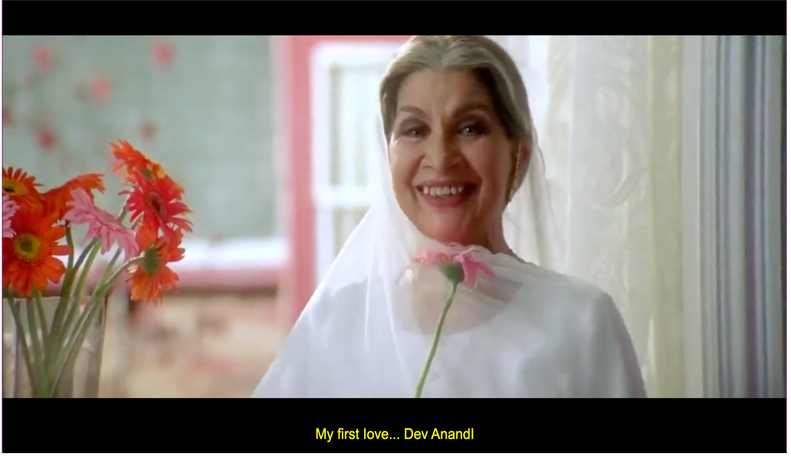
Figure 2

Figure 3
The diaspora’s growing influence led to a pressure amongst Hindi filmmakers to implement more Western visuals in their films,[45] which is the case of the first musical number, in which Western clothing, references to American iconography and the general ambience of an MTV music video take centre stage. Edward K. Chan’s analysis of the film substantiates this claim, as he writes, it actively and persistently seeks to ‘signify “America” as much as possible. The song draws heavily on musical Americana [through] Roy Orbison’s “Oh. Pretty Woman”’[46] which reiterates a sense of hybridity whereby the NRI must prioritise the ‘acculturation to the culture of their adopted country of living and working.’[47] Not only is the film’s rendition of ‘Pretty Woman’ infused with both Western pop/rock elements and Bhangra, but the entirety of the song’s mise-en-scène pays homage to Americana. First and foremost, the work of fashion designer and costume stylist Manish Malhotra features both shalwar kameez as well as tank tops and bright orange cargo pants, the latter of which is worn by Aman. This is conventional to Bollywood’s use of costume design, which often utilizes ‘exaggerated bright colours, a mixture of traditional Indian outfits with modern Western outfits, all projecting a heterogenous lifestyle that audiences are familiar with.’[48] The film is acutely aware that the NRI’s integration is dependent on their commitment to Americana and therefore dedicates itself to the relevant iconography. The break-dancers, basketball players and church choir celebrating on the streets of suburbia are all indicative of this, however the centrality of the American flag, which is hung on lampposts and used as a backdrop behind Aman (see fig. 4) reaffirms this commitment. This is heightened by the cinematography and editing style, which reflects that of an MTV music video through its rapid cuts and tracking shots that focus primarily on Aman’s singing and dancing. However, I would argue that assimilation within the West is not simply obtained through the NRI community, but also relies heavily on America embracing the NRI. Because of this, the song ‘becomes the perfect transcultural bridge between Bollywood and “America”: “America” is a happy multicultural society able to smoothly integrate Indians into its very fabric.’[49] Chan confirms these efforts as he writes, ‘indeed, a part of Bollywood’s charm for Americans might well be the self-exoticizing recognition of American culture in Bollywood songs’[50] which secures the objective of accepting Western culture as well as being accepted by the West.
Despite the promotions of cultural hybridity seen in ‘Pretty Woman’, the film’s third musical number ‘Challe Challo’ substantially rejects these notions. The moments preceding this song are concerned with the Kapur family’s failing American diner, which Aman proposes to transform into an Indian restaurant; ‘We have a power that we must take advantage of, that power is India. We must bring India to New York. Because Hindustan can do anything, anywhere, anytime.[51] Within the context of developing economic interest, the methodology begins to differ from that which we have seen in K3G, which indulges in the processes of Western capitalism. However exuberant mansions and business empires no longer capture the essence of the diaspora, instead the NRI is now encouraged to embrace their nationhood not only in the home but additionally in the workplace. This has become ‘the prototype of the new Indian, globalized and modern, but always a nationalist at heart… despite going through all types of ordeals, his “Indianness” is always reaffirmed at the end of the film.’[52] It is therefore fitting that ‘Challe Challo’, an anticolonial war cry from the sports drama Lagaan (2001) is used. The film ‘builds on Lagaan’s myth-making powers to promote an Indian identity that can encompass its diasporic citizens as well as its multi-ethnic natives.’[53] Therefore Aman’s plans to transform the American diner into an Indian restaurant is symbolic of the new, globalized, nationalist India, whose tools of liberation consist of rolling pins, karahis and samosas. Following this, the American flag is dethroned almost as quickly as it was raised (see fig. 5) as Café New York becomes Café New Delhi. As subalterns, this evokes a sense of liberation as characters decentre the West in their pursuit for success, by operating as ‘a united front and an extension of the imagined pre-eminence of their homeland.’[54] However, unlike Lagaan, which sought to liberate the Indian proletariat from the shackles of colonialism, KHNH does not establish the West as an oppressive establishment, nor does it disapprove of the standards that it imposes upon NRIs. Therefore one must proceed with caution when assuming that the film empowers its subaltern characters, when it actively ignores the group who established this category.
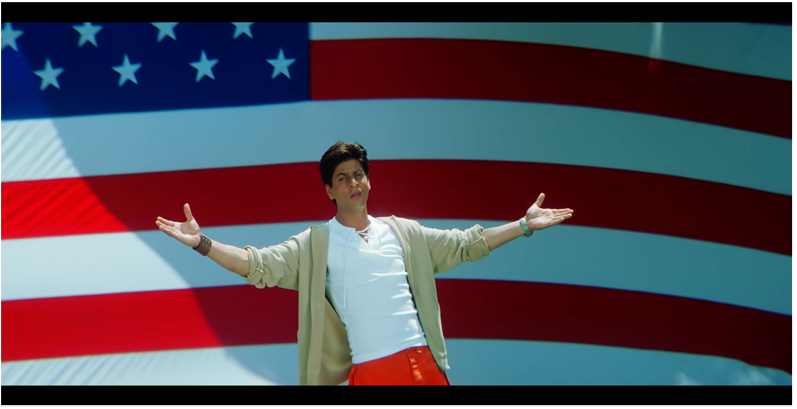
Figure 4

Figure 5
In contrast to this, although KHNH’s exploration of globalization and nationalism in both songs asserts that the diaspora must not be too Western, the film insists that they must still be Western enough – which implies the additional need to be Indian enough but not too Indian. Rohit’s momentary love interest Camilla is arguably the film’s most Westernized character due to her clothing, sexual prowess and materialism, all of which is used in order to villainize the character. Bollywood has historically chastised extreme adherences to the West, as evidence by K3G, as well as the film Purab aur Pashchim (1970) or ‘East and West’, which established the cliché of the ‘materialistic, corrupt, and sexually degenerate “West.”’[55] Furthermore, the film provides audiences with explicit case studies of those who are too Indian, particularly through the native Sikh characters whose ‘marginal cinematic representation, acts as a limit text that exposes the instability/inability of the national imagination.’[56] The Sikh family that arrives from India for Naina’s rishta (hand in marriage) conforms to this standard, which positions them in direct opposition to the NRI. The large family, who embody superficial stereotypes, includes; the stern-faced aunty, the timid sister-in-law and most of all ‘the Sikh buffoon’[57] all of whom are used as one-dimensional comedic reliefs that minimise the existence of native Punjabis. In spite of this, by concluding the narrative with an inter-caste relationship between the Punjabi Naina and Gujarati Rohit, the film attempts to overthrow these systems of classification, because ‘India can only succeed if its various constituents can create bridges across ethnic lines [Punjabis, Gujaratis], and “America” provides a neutral space to work out those differences’.[58] However the persistent tendency to do so within the limitations of being too Western or too Indian, ultimately restrains the NRI’s experience.
More so than K3G, it is clear that KHNH is a reflection of globalization’s rapid development, which is defined significantly by the diaspora community’s sense of cultural hybridity. At first glance, one may assume the productivity of this venture as the NRI no longer needs to choose between their country of residence and country and origin, however this sense of coexistence is nonetheless reminiscent of the subaltern. The subalterns of KHNH utilizes aspects of Western culture (i.e. Hollywood cinematic conventions, and American iconography) but simultaneously incorporates Hindustan’s cultural fixtures. However, ‘the native informant is co-opted for what Spivak calls the “New Empire,”’[59] thereby proving the intermediary’s regression towards colonial ideologies. Although the chapter recognizes that much of this adherence is intended to solidify the subaltern’s presence within the Western diaspora, the film’s monitoring of Eastern and Western values is evocative of the regulation of colonized minds and bodies. It is for this reason, that I conclude that KHNH does not relieve itself of colonial ideology, nor does it dismantle or disrupt Eurocentric, imperialist and capitalist processes.’[60]
Chapter Three: The Model Minority – My Name is Khan (2010)
Bollywood’s globalization reached new heights in the late 2000s with ‘concepts of modernity, cosmopolitanism, and Indian culture… ensuring a vision of South Asian Americans as model minority citizens, ones who embrace the empire and capital along with the residency, but nevertheless hold some affiliation with the homeland nation-state.’[61] Readers will be familiar with elements of this citizen, which have been partially present in both K3G and KHNH, however the next film adheres to this standard entirely. In addition to maintaining Hindustani values whilst assimilating within the US, this characterisation of the NRI became responsible for the maintenance of American ideologies and lifestyles. My Name is Khan (referred henceforth as MNIK) outlines the aftermath of Indian-Muslim Rizvan Khan’s life following the 9/11 attacks, after which he must continue to honour both his faith and allegiance to America. By concerning itself with this intensely divisive event, the film’s depiction of the model minority ‘becomes a cultural security blanket that… protects and insulates us from the harsher realities of racism and discrimination.’[62] Although the film acts as a beacon of hope for South Asians living in America post-2001, the film is also keen to address ‘the state’s construction of Muslims as cultural Others [which] has produced racialised subjects who have been framed by state policy and popular imagination, and have been simultaneously placed outside the realm of citizenship and international, national, and human rights.’[63] In doing so, there is an attempt to preserve the modern Indian’s place within the global sphere through rectifying the anxieties of Indians as well as Americans. This is because of the growing number of Bollywood films produced in partnership with Western production companies.[64] As a result, unlike previous chapters where ‘Western audiences’ referred to diasporic communities, this demographic will now encompass the plethora of non-desi citizens of the Global North who have become essential to this market.
The film’s opening scene exploits the audience’s anxieties by introducing a man (who we later know to be Khan), researching the travel itinerary of President George W. Bush, months before the 2008 General Election. As the character hurries through the airport, he appears to be on edge, reciting passages of the Quran to the himself, which plays with the audience’s biases that a terror attack may occur. The use of cinematography heightens this by obscuring Khan’s face whilst the score generates a sense of tension and foreboding. All of this builds to a crescendo until an Autism Alert card reveals the basis of this character’s behaviour, which interestingly positions audiences to no longer regard Khan as a threat. In this sense, the film asserts that the character’s unassuming demeanour exudes passivity and therefore should evoke sympathy from audiences, thereby constructing a model minority whose idiosyncrasies render him agreeable and most of all, governable. Furthermore, the exemplary work of model minorities, whose construct ‘is predominantly a reference to economic exceptionalism, upward mobility, and educational excellence’[65] is equally important to the composition of Khan’s character. Intelligence plays a pivotal role as it connotes a determination to become an exceptional subject, both willing to learn from and contribute to the West, which the film establishes through Khan’s time with Mr Wadia, a reclusive scholar who tutors Khan in his hometown Borivali, Mumbai. It should be noted that because this informal education takes places outside the parameters of Western pedagogical processes, there is a deviation from the Eurocentric standards which uphold the model minority. This can be viewed as Johar’s effort to prove that the Indian immigrant is already well-equipped with the tools to make it in America, which evokes a sense of nationalism. This sense of modernity conforms to that which we have seen in both K3G and KHNH, that NRIs are capable and dedicated subjects who use their Hindustani values to prosper.
This is propelled significantly through Khan and Mandira’s interfaith marriage, which attempts to repair the tumultuous history of Hindu-Muslim relations. It would be most useful to revisit this quotation referenced in the previous chapter, which reads, ‘India can only succeed if its various constituents can create bridges across ethnic lines… and “America” provides a neutral space to work out those differences’.[66] Khan and Mandira’s relationship is promoted as a microcosm of Hindustani values, which insist that all subgroups of the population must be empowered in order for the entire nation to succeed. By navigating this process, the film demonstrates that the NRI can and will assimilate accordingly in the West. This proclamation of the diaspora community’s propensity for acculturation is summarized in ‘Sajdaa’, which captures Khan and Mandira’s wedding and their early stages of married life. Influenced by qawwali, the music of Sufi Muslims, this musical format is deeply influenced by bhakti poetry, which refers to a movement in Hinduism that emphasises the intense emotional attachment to a personal God. Some Muslims adapted this to express a surrender to God, the vocabulary of which was narrated in terms of erotic love.[67] This unification of Hinduism and Islam is therefore deeply embedded in ‘Sajdaa’, which synthesizes their faiths and expressions of nationhood through the presentation of Mandira and Khan’s love. The frequent uses of slow-motion captures moments between the couple, thereby conveying the characters’ commitment to one another, their faiths and in turn, their nationhood. MNIK also promotes and rewards affiliations with Western capitalism, as evidenced by Khan’s brother Zakir, who declares earlier in the film, “This is America. The harder you work, the more successful you get.”[68] The song embodies this through a period of ‘personal and economic triumphs – Rizvan manages to hold down a job, and romances and marries Mandira, [they] move to a new town, and Mandira opens a hair salon at the exhortations of her American clientele.’[69] These successes symbolize assimilation for they represents the model minority’s ‘absorption of a certain consumerist version of modernity associated to his retention of core traditional... values.’[70] These traditional values are further emulated by the couple walking towards their house, hand in hand with their son Sameer, symbolizing the prosperity that emanates from conflating Eastern values with Western capitalism (see fig. 6). Furthermore, unlike the Kapur home in KHNH, Khan and Mandira’s home is not surrounded by an enclosed circle of fellow NRIs but white American families, including the Garricks. The song includes vignettes of the budding friendship between the Garricks and the Khans in which the families celebrate personal moments together. However, it is not simply the Khans who embrace American traditions, but also the Garricks who wear shalwar kameez and partake in poojas, thereby indicating a newfound dimension to cultural integration within the NRI community. Not only does the West acknowledge the existence of Indians in America (as seen in ‘Pretty Woman’), but the characters’ outward acceptance suggests that America rewards its immigrant subjects for assimilating.
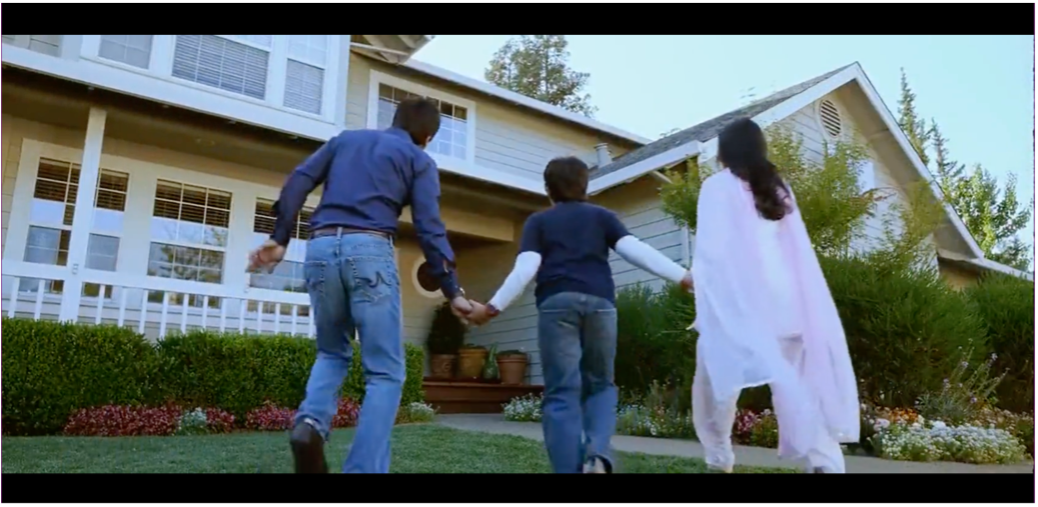
Figure 6
However, one must equally consider the unreliability of conforming to the model minority myth, as Tahseen Shams writes that while the stereotype ‘gives the appearance of providing security, stability and belongingness, with Asians being seemingly welcomed into the folds of American mainstream society, scholars have shown that this somewhat positive perception is fleeting and can slip away in moments of crisis.’[71] Following the 9/11 attack, Shams’ hypothesis becomes fulfilled as this security, stability and belongingness is suddenly obstructed by Western prejudice, ultimately dismissing prior efforts of integration. She continues, ‘this became all too clear when soon after 9/11, South Asian Americans found themselves no longer a glorified model minority but, conflated with Muslim and “Muslim-looking” groups, targets of virulent Islamophobic backlash and targeted surveillance.’[72] At this point, the film directs this Islamophobia towards Sameer (Mandira’s son) who is tragically murdered for being South Asian and additionally affiliated with Khan. In doing so, there is a sense in which the film establishes a juxtaposition between law-abiding Muslims and extremists to delineate the function and value of model minorities. However, at this point in the film, Mandira instinctively blames Khan for this act of racial prejudice rather than America’s systemic racism. This illustrates that the model minority must reconfigure themselves before looking to the system for refuge, therefore proving that ‘believing one’s group is a model minority can be a source of resilience for some immigrants because it provides a sense of accomplishment and acceptance from the dominant culture.’[73] Khan is the sheer embodiment of this practice as evidenced by his dedication to non-violent activism. The song ‘Noor E Khuda’ is instrumental to this, as it begins Khan’s journey of meeting the president to announce, “My name is Khan and I’m not a terrorist”. This motivation emanates from his love for Mandira, which signifies the love for his homeland as well as the desire to prove his commitment to America. The video’s projection of Khan’s resilience as a model minority begins as he walks through desolate roads in seclusion. The use of cinematography emphasizes this through an establishing shot of this rural landscape, symbolizing a long, arduous journey ahead, contrasting the suburbs, where Khan has most commonly been seen prior to this moment. However, Khan’s immersion in this desolation implies that his American allegiance runs much deeper than his suburban life of economic prosperity, but rather requires a true sense of dedicated patriotism that may or may not reward the patriot. On this taxing journey, which is dedicated solely to pacifism, Khan becomes part of an initiative in which characters ‘become activists and work within the existing state apparatus to introduce alterity into the national fabric in incremental steps.’[74] Fundamental to this process in MNIK, is the dedication to Islam, which Khan exercises earnestly in the line, “prayer should never depend on the people and place, it should only depend on your faith.”[75] In spite of the contentiousness associated with practicing Islam publicly following 9/11, Khan proceeds to perform his salah/nimaz (prayers) outside a rest stop, surrounded only by sand and trees, which the camerawork tracks through an arc shot. This resilience is once again promoted through staging a great distance between Khan and the onlookers, which signifies the detachment between communities, which the protagonist is gradually rectifying on his journey. Promoting his political message through acts of faith actualizes Khan’s peaceful approach yet ceases to evoke structural change, which appoints Khan as a paradigm of American freedom of speech. Although inspiring to surrounding South Asian-American characters, the film ceases to address the structural injustices imposed by the very nation he wishes to be accepted by, which encapsulates the paradox of the model minority.
It is evident from this analysis of MNIK that much like Johar’s previous endeavours, the characters must balance the cultures and customs of East and West, however this film differs in that it carries the burden of American patriotism in order to fully assimilate into Western society. Mandira’s heals from Sameer’s death by releasing red, white and blue balloons into the sky, which insinuates that Western patriotism is the only viable route of salvation and progress for NRIs. In doing so, ethnic minorities strive to secure a sense of assimilation that is far greater than mere acknowledgments by the West, instead they seek true acceptance and integration. The discussion of American race relations may be a sign of ‘the coming of age of Bollywood as a truly global media addressing a global audience and as a symbol of ambition of India as a world power. Indeed, it is now for Westerners and not fellow Indians to learn from NRIs.’[76] A seemingly liberating concept, this film insists that acculturation is not solely the diaspora’s responsibility but also that of the West, however the execution of this remains regressive. ‘The problem, as framed by the film, is one of cultural and social, rather than systemic and historical, prejudice.”[77] By framing the problem in this way, the film ‘forecloses the possibility for more radical anti-state action as it situates the problem in the realm of nation and culture.’[78] Furthermore, the West only assume responsibility on the basis that the diaspora community maintain their exemplary work. It should not be overlooked that the film actively chooses not to depict working class characters who reject American idealisms because this would have disrupted the politics of globalization, which as we know prioritises often Westernized, middle class characters. Although the model minority myth fulfils Western expectations, I insist that this sense of modernity is a continuation of India’s nationalism, which centralizes ‘global capitalist interests; passive stereotypes lingering from British colonial portrayals, and the depoliticization and commodification of “Indian culture.”’[79] Therefore we can deduce that the model minority emerged directly from colonial history, through ‘the opportunities for advancement’[80] that were ‘indoctrinated by Western education, this new political elite came to believe in and espouse the values and norms articulated by the Raj. They thus provided a mechanism for socialization, a medium through which British values seeped into Indian political culture.’[81] Khan’s commitment to upholding American patriotism in the face of adversity resembles this historical process, therefore we can once again surmise that the film’s exhibition of NRIs resorts to colonial ideology.
Conclusion
Bollywood’s globalization has undoubtedly transformed both the stylistic and thematic conventions of Hindi cinema for generations to come. The transformation of this format is a consequence of India’s national identity, which was expanded and delivered directly to the West through the processes of globalization. ‘This trend, as scholars have frequently noted, coincided with the liberalization of the Indian economy, the rise of new forms of cultural nationalism which reimagined the relation between the nation-state and its capitalist-rich diaspora’.[82] The implementation of Western capitalism, as well as the inclination to adopt Western cultural ideals and lifestyles ultimately defined the nation’s vision of modernity. However, despite efforts to incite a nationalist rhetoric through this, it is clear from my analysis that these ideals are maintained through Western frameworks. The cinematic representation of this in Bollywood is embodied entirely by the NRI, who actualizes this modernity through a dedication to Indian patriotism as well as a desire to assimilate within the West.
The first of my chosen films, Kabhi Khushi Kabhie Gham is the most resistant to expressions of Western customs and ideologies, as embracing such traditions was perceived to be synonymous with a loss of one’s Hindustani identity. The centralization of Hindutva is therefore essential to this approach, as evidenced by films ‘larded with patriotism.’[83] However even at its most nationalist, the transformation of market values imposed by globalization perpetuates standards of Western capitalism, whereby tradition is ‘retrofitted within the logic of the market and made to reinforce market priorities’[84] throughout the film. Kal Ho Naa Ho begins to embrace the inevitable hybridity of culture that emerges alongside the prominence of the NRI. The film ultimately embraces the presence of Hollywood conventions and American iconography, which is coupled with similar cries of patriotism that were observed in K3G. However it becomes clear that this operates within a hierarchical system that chastises those who conform too much or too little to both American and Indian ideals. This notion is encapsulated by the pattern of audiences ‘flock[ing] to Bollywood films as conveyors of a modernity that is neither American nor threatening to their fantasy of “tradition”’[85] Finally, My Name is Khan demonstrates a developed era of Bollywood cinema in which the NRI is not only accepted but integral to the functions of Western life. The sense of Indian identity in the film exceeds that of Hindutva, constructing a sense of cultural unity between American and Indian characters as well. This signals ‘the coming of age of Bollywood as a truly global media addressing a global audience’ acting as ‘a symbol of the ambition of India as a world power.’[86] However it is clear from my analysis that the model minority myth insights Indians to carry a responsibility that they need not bear.
To conclude, as Manisha Basu observes, ‘while it may appear that the character of globalized India is confused… globalization needs to be reconsidered perhaps as facilitating and enabling apparently oppositional values.’[87] This paradox defines contemporary Bollywood: it simultaneously critiques and capitalizes on the very Western frameworks it seeks to transcend. The NRI becomes the perfect emblem of this duality – an embodiment of cosmopolitan success and nationalist virtue, of belonging everywhere yet never entirely at home. Across Kabhi Khushi Kabhie Gham, Kal Ho Naa Ho, and My Name is Khan, globalization functions less as liberation than as reconfiguration; it repackages colonial hierarchies as aspirational modernity. As Shashi Tharoor reminds us, “imperial rule… fractured and distorted [India’s] cultural and self-perceptions,”[88] a distortion that persists beneath Bollywood’s glossy transnationalism. Despite its gestures toward hybridity and inclusion, the industry’s global turn continues to reproduce the moral, racial, and economic hierarchies inherited from empire. In the end, Bollywood’s globalization tells a story not of emancipation but of endurance – a cinema perpetually negotiating its freedom through the languages of its former colonizers, dreaming of modernity while still haunted by its colonial past.
[1] Roberts, Sheila. 2010. “Director Karan Johar Exclusive Interview.” Retrieved from http://www.collider.com/20 J 0/05/07 /director-karan-joharinterview-my-name-is-khan/
[2] Racine, J. (2008). Post-Post-Colonial India: From Regional Power to Global Player. Politique étrangère, Hors série(5), 65
[3] Rizvi, Gowher. "Emergent India: Globalization, Democracy, and Social Justice." International Journal (Toronto) 62, no. 4 (2007): 754
[4] In 1995, Kothari wrote ‘Under Globalisation: Will Nation State Hold?’ in which he outlines India’s erosion of power, which began during the former half of the decade at the hands of foreign intervention and the global market
[5] Oza, Rupal. The Making of Neoliberal India: Nationalism, Gender, and the Paradoxes of Globalization Routledge, 2012: 4
[6] Tripathy, Manisha. "Globalisation and Social Transformation in India: Theorising the Transition." International Journal of Sociology and Anthropology 3, no. 8 (2011): 253
[7] Therwath, Ingrid. "‘Shining Indians’: Diaspora and Exemplarity in Bollywood." South Asia Multidisciplinary Academic Journal no. 4 (2010): 4
[8] (Gopal 2011: 18)
[9] Gopal, Sangita. ‘Sentimental Symptoms: The Films of Karan Johar and Bombay Cinema’: Bollywood and Globalization: Indian Popular Cinema, Nation, and Diaspora Anthem Press, 2011: 18
[10] Sharma, Arvind. "On Hindu, Hindustān, Hinduism and Hindutva." Numen 49, no. 1 (2002): 24
[11] Siddiqui, Kalim. "Hindutva, Neoliberalism and the Reinventing of India." Journal of Economic and Social Thought 4, no. 2 (2017): 167
[12] Joshi, Priya. “4. Bollywood, Bollylite.” Bollywood’s India, 91-124: Columbia University Press. 2015: 96
[13] (Gopal 2011: 25)
[14] Thakur, Gautam Basu. ‘Globalization and the Cultural Imaginary: Constructions of Subjectivity, Freedom and Enjoyment in Popular Indian Cinema’: Bollywood and Globalization: Indian Popular Cinema, Nation, and Diaspora Anthem Press, 2011: 90
[15] Sharpe, Jenny. "Gender, Nation, and Globalization in Monsoon Wedding and Dilwale Dulhania Le Jayenge." In Global Migration, Social Change, and Cultural Transformation, 37-57: Springer, 2007: 41
[16] Dwyer, Rachel. "Bollywood's Empire: Indian Cinema and the Diaspora." In Routledge Handbook of the South Asian Diaspora, 415: Routledge, 2014.
[17] (Joshi 2015: 123)
[18] (Therwath 2010, 11)
[19] Davies, Gloria., and Nyland, Chris. Globalization in the Asian Region: Impacts and Consequences. Cheltenham ; Northampton, MA.: Edward Elgar, 2004: 92
[20] Sanjeev Kumar H.M "Constructing the Nation's Enemy: "Hindutva", Popular Culture and the Muslim 'Other' in Bollywood Cinema." Third World Quarterly 34, no. 3 (2013): 458 http://www.jstor.org/stable/42002135.
[21] (Sharpe 2007: 42)
[22] Elliott, Michael. "India Awakens: Fueled by High-Octane Growth, the World's Largest Democracy is Becoming a Global Power. Why the World Will Never be the Same." (2006), quoted in Ganti, Tejaswini. Producing Bollywood Duke University Press, 2012: 2
[23] (Ganti 2012: 17)
[24] Hansen, Thomas Blom. "Globalisation and Nationalist Imaginations: Hindutva's Promise of Equality through Difference." Economic and Political Weekly 31, no. 10 (1996): 607
[25] Jaffrelot, Christophe. "Hindutva." In Key Concepts in Modern Indian Studies, edited by Dharampal-Frick, Gita, Monika Kirloskar-Steinbach, Rachel Dwyer and Jahnavi Phalkey, 110: NYU Press, 2015
[26] (Hansen 1996: 610)
[27] Malhotra, Sheena and Tavishi Alagh. "Dreaming the Nation: Domestic Dramas in Hindi Films Post-1990." South Asian Popular Culture 2, no. 1 (2004): 26
[28] (Joshi 2015: 121)
[29] (Siddiqui 2017: 145)
[30] (Joshi 2015: 115)
[31] Beeman, Angie and Anjana Narayan. "If You’re White, You’re Alright: The Reproduction of Racial Hierarchies in Bollywood Films." In Covert Racism, 155-173: Brill, 2011: 156
[32] (Therwath 2011: 7-8)
[33] (Sharpe 2007: 44)
[34] Holtzman, Dinah. "Between Yaars: The Queering of Dosti in Contemporary Bollywood Films." Bhattacharya-Mehta, R & Pandharipande (2011): 121
[35] Dalrymple, William. The Anarchy: The Relentless Rise of the East India Company Bloomsbury Publishing, 2019: 108
[36] (Dalrymple 2019: 465)
[37] (Joshi 2015: 121-2
[38] (Therwath 2010: 9)
[39] Spivak, Gayatri Chakravorty, Nelson Cary, and Grossberg Lawrence. “Can the Subaltern Speak?” Marxism and the Inrerpretation of Culture (1988): 284
[40] (Spivak, Nelson and Grossberg 1988: 285)
[41] (Therwath 2010: 10)
[42] Koshy, Minu Susan. "Rhythmanalysing New York through Diasporic Lens: A Study of Nikhil Advani's Kal Ho Naa Ho and Karan Johar's Kabhi Alvida Naa Kehna." Ars Artium (2016): 126
[43] (Sharpe 2007: 38)
[44] Maggio, J. "“Can the Subaltern be Heard?”: Political Theory, Translation, Representation, and Gayatri Chakravorty Spivak." Alternatives 32, no. 4 (2007): 431
[45] Anujan, Divya, David J. Schaefer, and Kavita Karan. "7 The Changing Face of Indian Women in the Era of Global Bollywood." Bollywood and Globalization: The Global Power of Popular Hindi Cinema (2012a): 112
[46] Chan, Edward K. "On Returning: “America'” in the Fifth Element and Kal Ho Naa Ho." Genre: Forms of Discourse and Culture 38, no. 4 (2005): 402
[47] Kavita Karan. “9 Cultural Connections in a globalized world.” Bollywood and Globalization: The Global Power of Popular Hindi Cinema (2012a): 148
[48] Chatterjee, Deepsikha and Cheri Vasek. "Bollywood: Cross Pollination between Film Costumes and Fashion." Null 12, no. 2 (2020): 238
[49] (Chan 2005: 403)
[50] (Chan 2005: 403)
[51] Advani, Nikhil. Kal Ho Naa Ho (2003). India: Dhamra Productions, 28 November 2003. Film (1:08:32)
[52] (Therwath 2010: 6)
[53] O'Neill, Patricia. "Imagining Global India: Bollywood's Transnational Appeal." Continuum (Mount Lawley, W.A.) 27, no. 2 (2013): 261
[54] (O’Neill 2013: 261)
[55] Mehta, Rini Bhattacharya. "Bollywood, Nation, Globalization: An Incomplete Introduction." In Bollywood and Globalization: Indian Popular Cinema, Nation, and Diaspora, 7: Anthem Press, 2010.
[56] Singh, Harleen. "TUR(BANNED) MASCULINITIES: Terrorists, Sikhs, and Trauma in Indian Cinema." Null 2, no. 2 (2006): 116
[57] (Singh 2006: 116)
[58] (Chan 2005: 408)
[59] (Maggio 2007: 427)
[60] Desai, Jigna. "Bollywood Abroad: South Asian Diasporic Cosmopolitanism and Indian Cinema." New Cosmopolitanisms: South Asians in the US (2006): 127
[61] (Desai 2006: 129-30)
[62] Mahalingam, Ramaswami. "Misidentification, Misembodiment and the Paradox of being a Model Minority." Null 8, no. 3 (2012): 300
[63] Pope, Heather E. and Victoria M. Bryan. Reflecting 9/11 : New Narratives in Literature, Television, Film and Theatre. Newcastle upon Tyne, England: Cambridge Scholars Publishing, 2016: 213
[64] (Therwath 2010: 11)
[65] Puar, Jasbir K. and Amit Rai. "The Remaking of a Model Minority: Perverse Projectiles Under the Specter of (Counter) Terrorism." Social Text 22, no. 3 (2004): 75
[66] (Chan 2005: 408)
[67] Menon, Madhavi. Infinite Variety: A History of Desire in India. New Delhi: Speaking Tiger, 2018: 67
[68] Johar, Karan. My Name is Khan (2010). India/US: Dharma Productions, Red Chillies Entertainment and Fox Star Studios, 12 February 2010. Film (0:25:42)
[69] (Pope 2016: 218)
[70] (Therwath 2010: 11)
[71] Shams, Tahseen. "Successful Yet Precarious: South Asian Muslim Americans, Islamophobia, and the Model Minority Myth." Sociological Perspectives 63, no. 4 (2020): 654
[72] (Shams 2020: 654)
[73] (Mahalingam 2012: 301)
[74] (Pope 2016: 214)
[75] (Johar 2010: 1:40:06)
[76] (Therwath 2010, 11)
[77] (Pope 2016: 220)
[78] (Pope 2016: 220)
[79] Chandrasekaran, Priya Rajalakshmi. "Unsettling "Indian American Hindus" and Model Minority Projects in Trump-Era "America"." Berkeley Journal of Sociology 61, (2017): 38
[80] Ikenberry, G. J. and Charles A. Kupchan. "Socialization and Hegemonic Power." International Organization 44, no. 3 (1990): 310
[81] Ikenberry, G. J. and Charles A. Kupchan. "Socialization and Hegemonic Power." International Organization 44, no. 3 (1990): 310
[82] (Gopal 2011: 18)
[83] (Joshi 2015: 115)
[84] (Joshi 2015: 115)
[85] (Joshi 2015: 96)
[86] (Therwath 2010, 11-2)
[87] Basu, Manisha. "Rang De Basanti: The Solvent Brown and Other Imperial Colors." In Bollywood and Globalization: Indian Popular Cinema, Nation, and Diaspora, 93-110: Anthem Press, 2010: 91
[88] Tharoor, Shashi. An Era of Darkness: The British Empire in India. New Delhi, India: Aleph, 2016.: 139
Bibliography:
Anujan, Divya, David J. Schaefer, and Kavita Karan. "7 the Changing Face of Indian Women in the Era of Global Bollywood1." Bollywood and Globalization: The Global Power of Popular Hindi Cinema (2012): 110.
Asif, Noor A. "Understanding Postcolonial South Asian Communities through Bollywood." (2016).
Banerjee, Sikata. Gender, Nation and Popular Film in India: Globalizing Muscular Nationalism Routledge, 2016.
Basu, Manisha. "Rang De Basanti: The Solvent Brown and Other Imperial Colors." In Bollywood and Globalization: Indian Popular Cinema, Nation, and Diaspora, 93-110: Anthem Press, 2010.
Beeman, Angie and Anjana Narayan. "If You’re White, You’re Alright: The Reproduction of Racial Hierarchies in Bollywood Films." In Covert Racism, 155-173: Brill, 2011.
Bose, Mihir. Bollywood: A History Roli Books Private Limited, 2008.
Chakravarty, Sumita S. National Identity in Indian Popular Cinema, 1947-1987 University of Texas Press, 2011.
Chan, Edward K. "On Returning:“America'” in the Fifth Element and Kal Ho Naa Ho." Genre: Forms of Discourse and Culture 38, no. 4 (2005): 389-412.
CHANDRASEKARAN, PRIYA RAJALAKSHMI. "Unsettling "Indian American Hindus" and Model Minority Projects in Trump-Era "America"." Berkeley Journal of Sociology 61, (2017): 32-43. http://www.jstor.org/stable/45221641.
Chatterjee, Deepsikha and Cheri Vasek. "Bollywood: Cross Pollination between Film Costumes and Fashion." Null 12, no. 2 (2020): 219-244. doi:10.1080/17569370.2020.1769357. https://doi.org/10.1080/17569370.2020.1769357.
Dalrymple, William. The Anarchy: The Relentless Rise of the East India Company Bloomsbury Publishing, 2019.
Desai, Jigna. "Bollywood Abroad: South Asian Diasporic Cosmopolitanism and Indian Cinema." New Cosmopolitanisms: South Asians in the US (2006): 115-137.
Dwyer, Rachel. "Bollywood'S Empire: Indian Cinema and the Diaspora." In Routledge Handbook of the South Asian Diaspora, 409-418: Routledge, 2014.
Elliott, Michael. "India Awakens: Fueled by High-Octane Growth, the World's Largest Democracy is Becoming a Global Power. Why the World Will Never be the Same." (2006).
Ganti, Tejaswini. Producing Bollywood Duke University Press, 2012.
Hansen, Thomas Blom. "Globalisation and Nationalist Imaginations: Hindutva's Promise of Equality through Difference." Economic and Political Weekly 31, no. 10 (1996): 603-616. http://www.jstor.org/stable/4403889.
Holtzman, Dinah. "Between Yaars: The Queering of Dosti in Contemporary Bollywood Films." Bhattacharya-Mehta, R & Pandharipande (2011): 111-128.
Ikenberry, G. J. and Charles A. Kupchan. "Socialization and Hegemonic Power." International Organization 44, no. 3 (1990): 283-315. http://www.jstor.org/stable/2706778.
JAFFRELOT, CHRISTOPHE. "Hindutva." In Key Concepts in Modern Indian Studies, edited by Dharampal-Frick, Gita, Monika Kirloskar-Steinbach, Rachel Dwyer and Jahnavi Phalkey, 108-110: NYU Press, 2015. http://www.jstor.org/stable/j.ctt15zc7zj.45.
Joshi, Priya. "4. Bollywood, Bollylite." In Bollywood's India, 91-124: Columbia University Press, 2015.
Karan, Kavita. "Cultural Connections in a Globalized World: The Power of Bollywood in the United States." In Bollywood and Globalization, 166-186: Routledge, 2012.
Kavita Karan. “9 Cultural Connections in a globalized world.” Bollywood and Globalization: The Global Power of Popular Hindi Cinema (2012a): 146-166
Khan, Shehreen Ataur. "Bollywood Lyrics: Stereotypical Miss-Representation." East West Journal of Humanities (: 67.
Maggio, J. "“Can the Subaltern be Heard?”: Political Theory, Translation, Representation, and Gayatri Chakravorty Spivak." Alternatives 32, no. 4 (2007): 419-443. doi:10.1177/030437540703200403. https://doi.org/10.1177/030437540703200403.
Mahalingam, Ramaswami. "Misidentification, Misembodiment and the Paradox of being a Model Minority." Null 8, no. 3 (2012a): 299-304. doi:10.1080/17448727.2012.752679. https://doi.org/10.1080/17448727.2012.752679.
———. "Misidentification, Misembodiment and the Paradox of being a Model Minority." Null 8, no. 3 (2012b): 299-304. doi:10.1080/17448727.2012.752679. https://doi.org/10.1080/17448727.2012.752679.
Malhotra, Sheena and Tavishi Alagh. "Dreaming the Nation: Domestic Dramas in Hindi Films Post-1990." South Asian Popular Culture 2, no. 1 (2004): 19-37.
Manisha, Tripathy P. "Globalisation and Social Transformation in India: Theorising the Transition." International Journal of Sociology and Anthropology 3, no. 8 (2011): 253-260.
Mehta, Rini Bhattacharya. "Bollywood, Nation, Globalization: An Incomplete Introduction." In Bollywood and Globalization: Indian Popular Cinema, Nation, and Diaspora, 1-198: Anthem Press, 2010.
Menon, Madhavi. Infinite Variety : A History of Desire in India. New Delhi: Speaking Tiger, 2018.
O'Neill, Patricia. "Imagining Global India: Bollywood's Transnational Appeal." Continuum (Mount Lawley, W.A.) 27, no. 2 (2013): 254-266. doi:10.1080/10304312.2013.766309.
Oza, Rupal. The Making of Neoliberal India: Nationalism, Gender, and the Paradoxes of Globalization Routledge, 2012.
Pope, Heather E. and Victoria M. Bryan. Reflecting 9/11 : New Narratives in Literature, Television, Film and Theatre. Newcastle upon Tyne, England: Cambridge Scholars Publishing, 2016.
Puar, Jasbir K. and Amit Rai. "The Remaking of a Model Minority: Perverse Projectiles Under the Specter of (Counter) Terrorism." Social Text 22, no. 3 (2004): 75-104.
Racine, J. (2008). Post-Post-Colonial India: From Regional Power to Global Player. Politique étrangère, Hors série(5), 65-78.
Rizvi, Gowher. "Emergent India: Globalization, Democracy, and Social Justice." International Journal (Toronto) 62, no. 4 (2007): 753-768. doi:10.1177/002070200706200403.
SANJEEV KUMAR, H. M. "Constructing the Nation's Enemy: "Hindutva", Popular Culture and the Muslim 'Other' in Bollywood Cinema." Third World Quarterly 34, no. 3 (2013): 458-469. http://www.jstor.org/stable/42002135.
Sarkar, Tanika. "Birth of a Goddess: 'Vande Mataram', "Anandamath", and Hindu Nationhood." Economic and Political Weekly 41, no. 37 (2006): 3959-3969. http://www.jstor.org/stable/4418703.
Shams, Tahseen. "Successful Yet Precarious: South Asian Muslim Americans, Islamophobia, and the Model Minority Myth." Sociological Perspectives 63, no. 4 (2020a): 653-669.
———. "Successful Yet Precarious: South Asian Muslim Americans, Islamophobia, and the Model Minority Myth." Sociological Perspectives 63, no. 4 (2020b): 653-669. doi:10.1177/0731121419895006. https://doi.org/10.1177/0731121419895006.
Sharma, Arvind. "On Hindu, Hindustān, Hinduism and Hindutva." Numen 49, no. 1 (2002): 1-36. http://www.jstor.org/stable/3270470.
Sharpe, Jenny. "Gender, Nation, and Globalization in Monsoon Wedding and Dilwale Dulhania Le Jayenge." In Global Migration, Social Change, and Cultural Transformation, 37-57: Springer, 2007.
SIDDIQUI, Kalim. "Hindutva, Neoliberalism and the Reinventing of India." Journal of Economic and Social Thought 4, no. 2 (2017a): 142-186. doi:http://dx.doi.org/10.1453/jest.v4i2.1280. https://www.proquest.com/scholarly-journals/hindutva-neoliberalism-reinventing-india/docview/1934359197/se-2?accountid=11862 http://sfx.kcl.ac.uk/kings?url_ver=Z39.88-2004&rft_val_fmt=info:ofi/fmt:kev:mtx:journal&genre=article&sid=ProQ:ProQ%253Aturkey&atitle=Hindutva%252C+Neoliberalism+and+the+Reinventing+of+India&title=Journal+of+Economic+and+Social+Thought&issn=21490422&date=2017-06-01&volume=4&issue=2&spage=142&au=SIDDIQUI%252C+Kalim&isbn=&jtitle=Journal+of+Economic+and+Social+Thought&btitle=&rft_id=info:eric/&rft_id=info:doi/10.1453%252Fjest.v4i2.1280 http://dx.doi.org/10.1453/jest.v4i2.1280.
———. "Hindutva, Neoliberalism and the Reinventing of India." Journal of Economic and Social Thought 4, no. 2 (2017b): 142-186. doi:http://dx.doi.org/10.1453/jest.v4i2.1280. https://www.proquest.com/scholarly-journals/hindutva-neoliberalism-reinventing-india/docview/1934359197/se-2?accountid=11862.
Singh, Harleen. "TUR(BANNED) MASCULINITIES: Terrorists, Sikhs, and Trauma in Indian Cinema." Null 2, no. 2 (2006): 115-124. doi:10.1080/17448720601061325. https://doi.org/10.1080/17448720601061325.
Thakur, Gautam. "Globalization and the Cultural Imaginary: Constructions of Subjectivity, Freedom and Enjoyment in Popular Indian Cinema." Bollywood and Globalization: Indian Popular Cinema, Nation, and Diaspora (2011a): 75-92.
———. "Globalization and the Cultural Imaginary: Constructions of Subjectivity, Freedom and Enjoyment in Popular Indian Cinema." Bollywood and Globalization: Indian Popular Cinema, Nation, and Diaspora (2011b): 75-92.
Tharoor, Shashi. An Era of Darkness : The British Empire in India. New Delhi, India: Aleph, 2016.
Therwath, Ingrid. "‘Shining Indians’: Diaspora and Exemplarity in Bollywood." South Asia Multidisciplinary Academic Journal no. 4 (2010).
Tripathy, Manisha. "Globalisation and Social Transformation in India: Theorising the Transition." International Journal of Sociology and Anthropology 3, no. 8 (2011a): 253-260.
———. "Globalisation and Social Transformation in India: Theorising the Transition." International Journal of Sociology and Anthropology 3, no. 8 (2011b): 253-260
Filmography:
Johar, Karan. Kabhi Khushi Kabhie Gham (2001). India: Dharma Productions, 14 December 2001. Film
Advani, Nikhil. Kal Ho Naa Ho (2003). India: Dharma Production, 28 November 2003. Film
Johar, Karan. My Name is Khan (2010). India/US: Dharma Productions, Red Chillies Entertainment and Fox Star Studios, 12 February 2010. Film